How to Appropriately Select a Patient Lift for Persons with Disabilities According to User Needs?
Patient Lifts for Persons with Disabilities – Which to Choose? Select the Appropriate Patient Lift.
On this page
Working with individuals who have limited mobility places caregivers—physiotherapists, nurses, aides, and family members—at high risk of musculoskeletal strain. Even simple tasks such as repositioning, transferring from bed to wheelchair, or toileting demand considerable physical effort from both patient and attendant, and may pose significant challenges. Patients who are bedbound or partially mobile also face social, economic, and health-related burdens. To address these issues, ever more advanced medical devices have entered the market—among them, patient lifts for persons with disabilities. Yet, with so many models available, selecting the appropriate lift can be difficult. A well-chosen device must suit the patient’s degree of mobility and physical characteristics, as well as the caregiver’s preferences and the care setting.
What Is a Patient Lift?
A patient lift is an innovative medical device designed to enable safe, effort-free elevation and transfer of people with impaired mobility. It facilitates routine activities—primarily position changes—and aids in transporting and moving the patient. Transferring someone from bed to wheelchair or toilet without a lift requires great strength from the caregiver, imposes heavy loads on the musculoskeletal system, and increases risks of herniated discs or joint degeneration. A correctly selected lift minimizes these hazards, enhancing safety and comfort for both patient and caregiver.
Lifts for the disabled offered by Meden-Inmed
Types of Patient Lifts for Persons with Disabilities Tailored to Specific Needs
Patient Lifts of Polish Manufacture – Meden-Inmed
When choosing a lift or stand-assist device, several parameters must be considered. One is the location of use. In hospitals or care homes, larger-scale equipment may be acceptable. For home use, attention should be paid to room dimensions and potential architectural barriers affecting patient transport. Equally important are compactness, ergonomics, and the ability to fold the device for storage.
Sit-to-Stand Lifts
An essential criterion for selecting a lift or stand-assist device is the patient’s level of mobility restriction. Sit-to-stand lifts are ideal for patients who can shift from standing to sitting with caregiver assistance. Such lifts eliminate the need for the caregiver to bear the load while allowing the patient to engage in independent movement with minimal physical effort. This promotes physical conditioning and psychological well-being. Sit-to-stand lifts also support patients in ambulation while upright.
Mobile Lifts
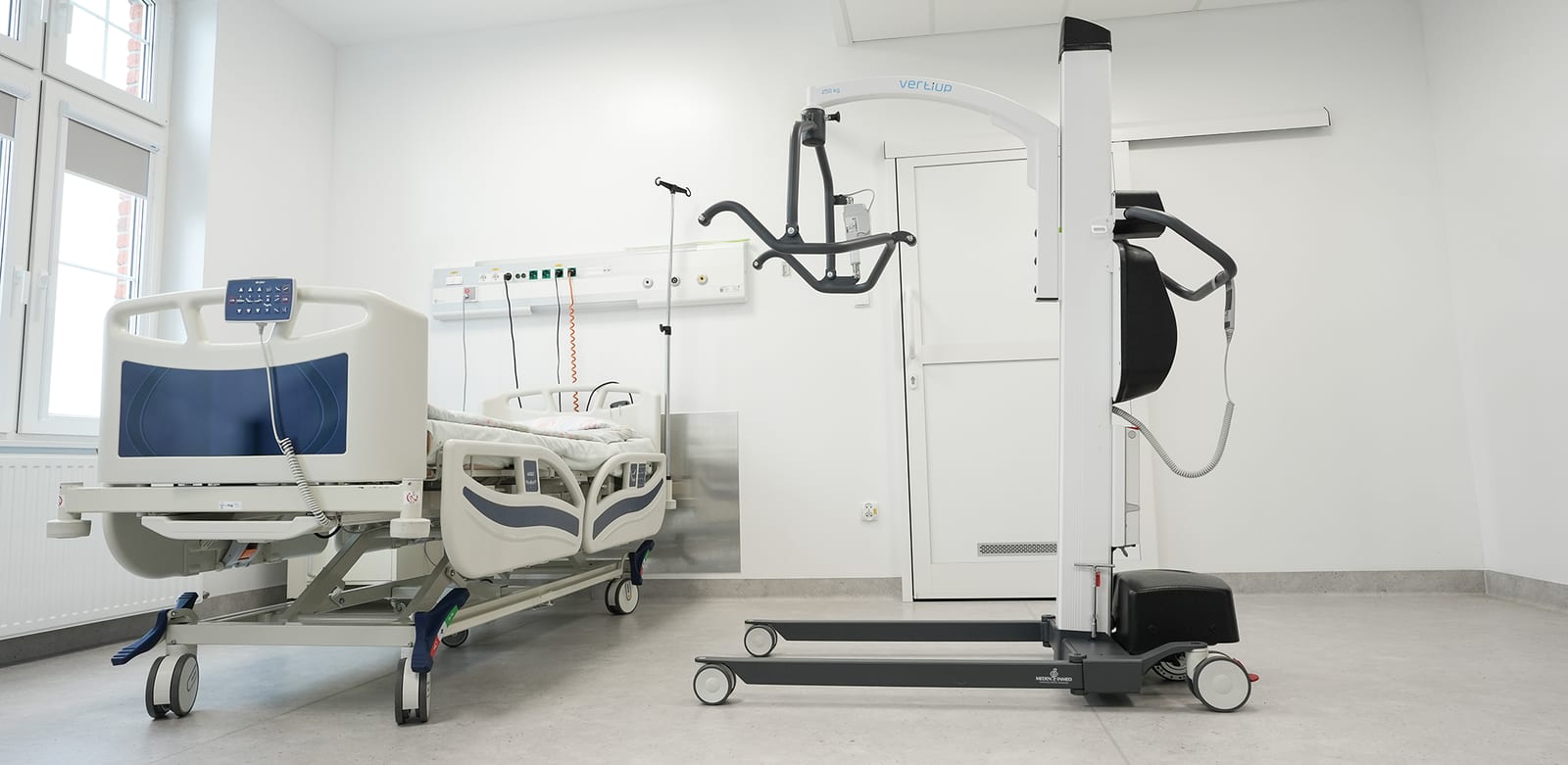
Mobile lifts are intended for individuals with more profound mobility limitations. They serve to lift, transfer, and transport patients in a seated or semi-reclined position in full suspension via specialized slings. For patients with low mobility who cannot stabilize the upper trunk and neck, high-back slings are required, enabling lifts directly from and to a supine position. When lifting from the floor (e.g., after fainting or falls), a lift with a boom range starting at approximately 30 cm is advisable to minimize the caregiver’s arm reach.
For patients who can maintain head, cervical, and upper-torso stability, medium- or low-back slings are recommended, allowing seated or semi-reclined transfers. Bath-toilet slings are also available to facilitate hygiene care while maximizing comfort for both patient and caregiver.
Patient Lifts for Bariatric Patients
In institutional settings, equipment should be as universal as possible. A facility’s lift must be suitable for daily use, have adequate load capacity for a range of patient weights, and be easy to maneuver. For bariatric care, the device requires a reinforced design that safely accommodates higher weight limits. Adjustable base-leg spread—controlled manually via a foot pedal or by remote control—is also valuable, allowing the lift to clear bed frames, wheelchair wheels, and other obstacles. In home environments, compactness—foldability and overall weight—becomes especially important when frequent transport of the lift is anticipated.
Summary of Information on Patient Lifts for Persons with Disabilities
The goal of modern care is to improve patients’ quality of life while easing the caregiver’s workload. Mechanical aids in the form of lifts and stand-assist devices facilitate patient handling, transfer, and transport. Patient lifts enhance safety and comfort for both patient and caregiver. Without proper equipment, caregivers often adopt awkward postures—bending and twisting—which, combined with excessive force, increase the risk of overuse injuries, particularly in the lumbar spine. Therefore, minimizing physical exertion through appropriate lift selection is crucial to ensure ergonomic care and improve the patient’s psychological comfort.